

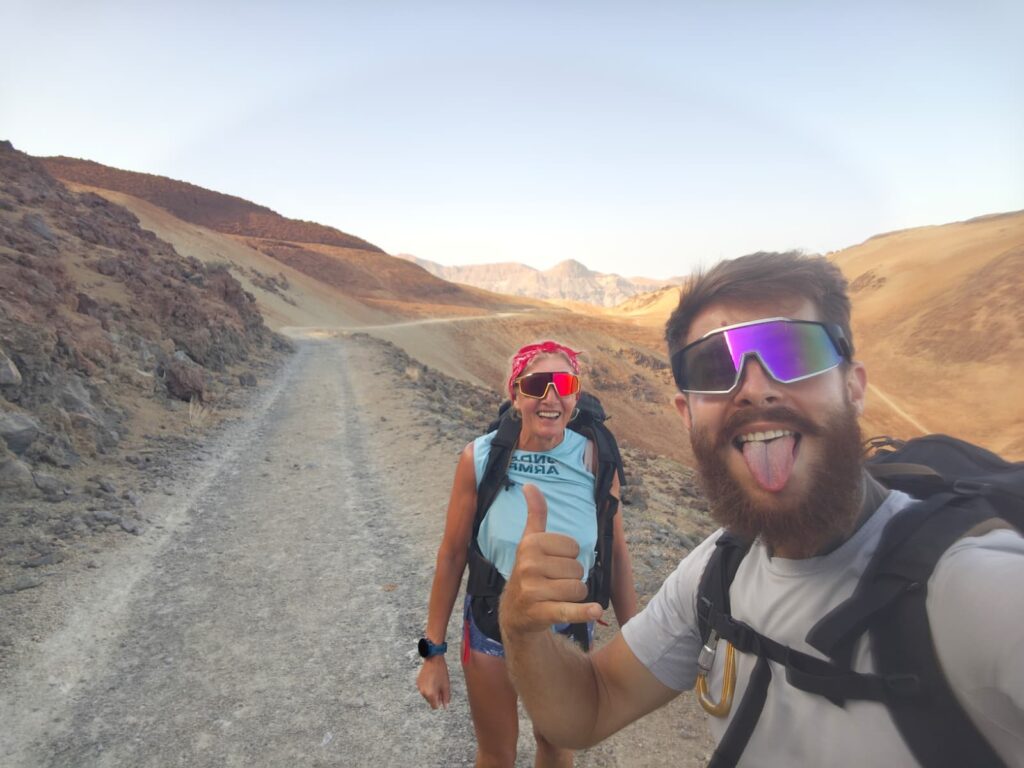
Teresa is 60 and has more energy than plenty of people half her age. She flew to Tenerife for canyoning. She also had a second dream: to climb Teide. On foot, not by cable car. So we went.
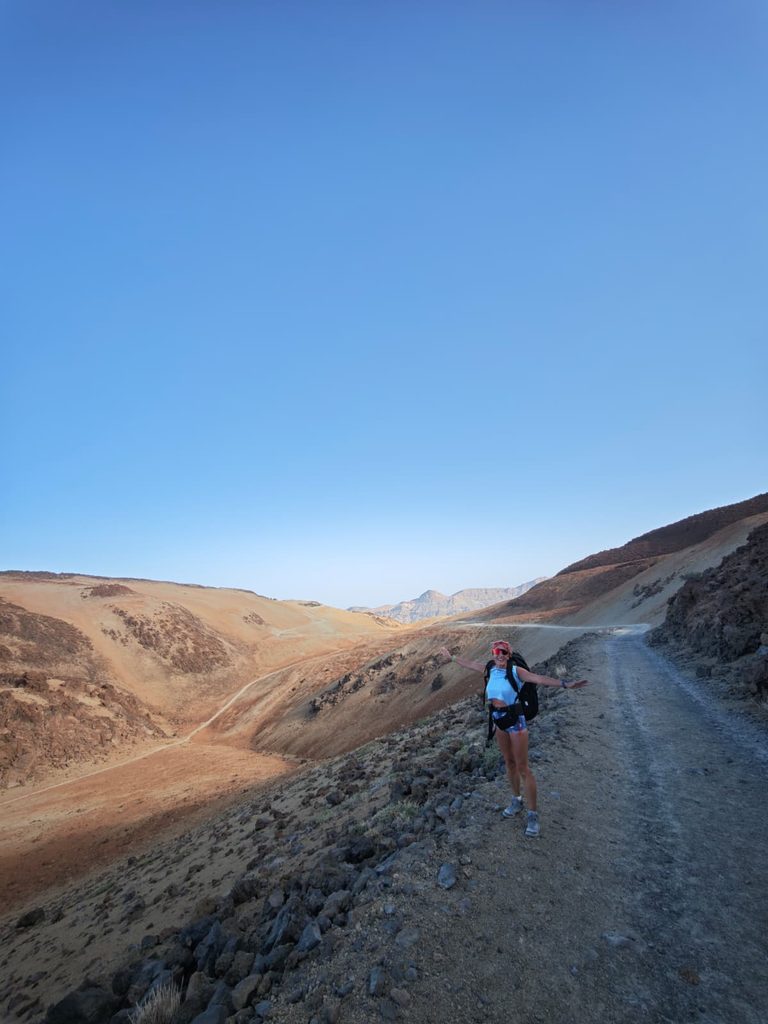
Starting from the Montaña Blanca car park
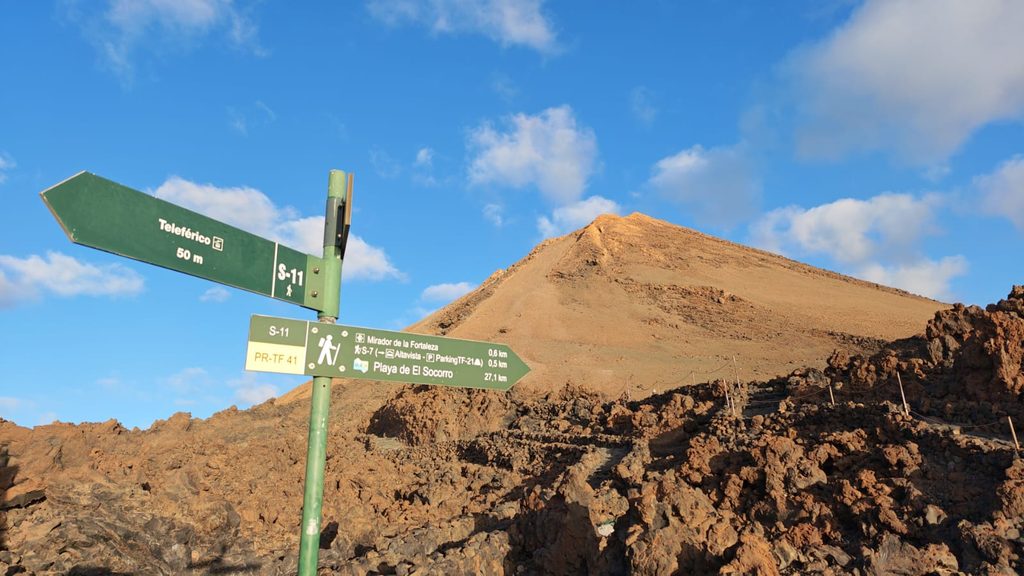
Trail 7 starts on the TF-21 road, at about 2,350 m. We set off around 18:00. There was a calima that day, hot air full of dust from the Sahara. Even so, it was only about 20 degrees at the car park. Down on the coast people were still on the beach.
The first kilometres follow a wide gravel track through a pale pumice landscape. It looks like another planet. On the way you pass the Huevos del Teide, huge black balls of solid lava.
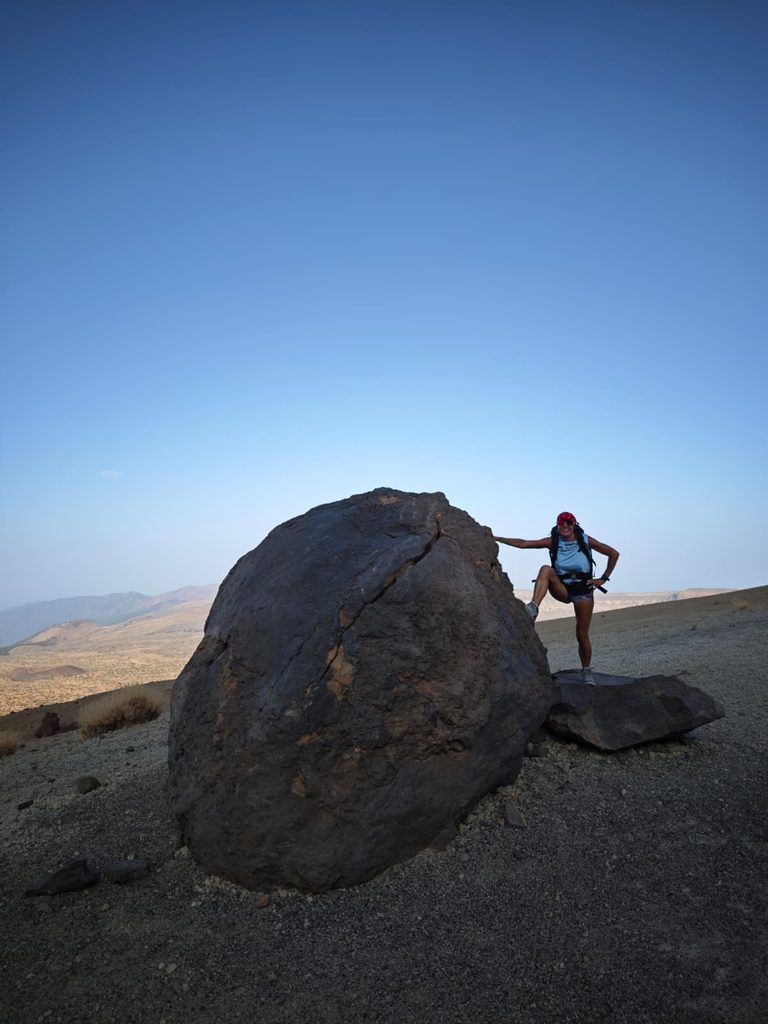
Where the Teide eggs came from
They look as if someone placed them there on purpose.
About a thousand years ago Teide erupted from its summit for the last time. Thick black lava, the Lavas Negras, ran down the slopes. You can still see it as dark tongues on the cone. Lava like that moves slowly. Its front cools, cracks, and every now and then a glowing block breaks off.
The slope is steep, so the block starts to roll. As it goes, it picks up layer after layer of half molten lava. It works exactly like a snowball: the further it rolls, the bigger it gets. At the bottom the slope flattens out, the ball slows, stops and cools. Geologists call them accretionary lava balls.
That is why they stand out so much. The black lava from Teide sits on pale pumice from the much older Montaña Blanca eruption. Two different eruptions, two colours, one photo.
The biggest are several metres across. You pass more than a dozen along trail 7, a good excuse for a short break before the switchbacks.
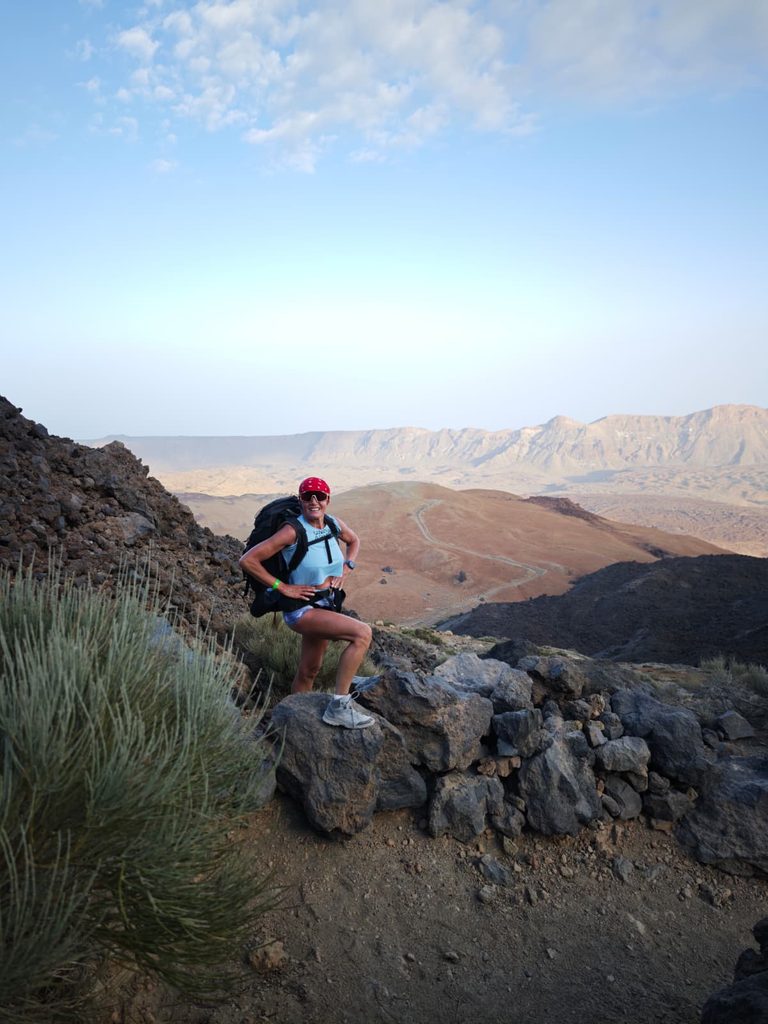
The climb to the refuge
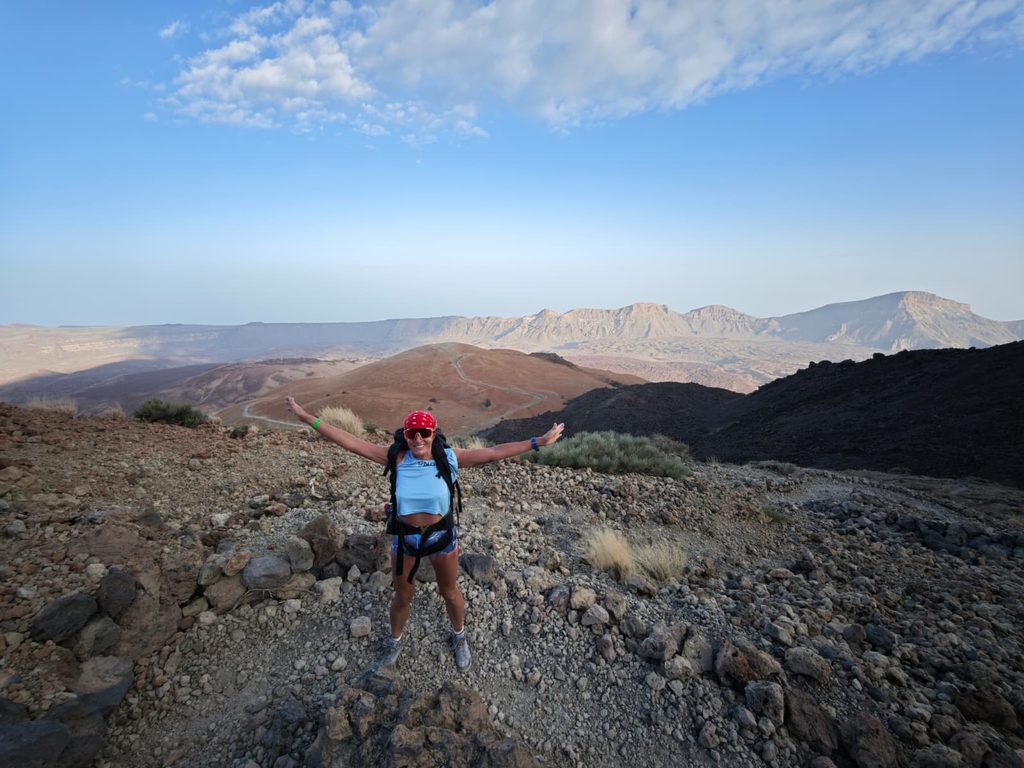
Switchbacks, loose gravel and less and less oxygen. We reached the refuge in 2 hours. That is a strong pace. Most people need 3 to 4 hours, and there is nothing wrong with that. At this altitude the winner is not the one who walks fast. It is the one who walks steadily.
After sunset the temperature dropped to about 14 degrees. And that was a warm evening, with the calima.
The Altavista refuge after the renovation: what it is like and what it costs
The Refugio de Altavista stands at 3,260 m above sea level. It closed during the pandemic and stood empty for years. In July 2026 it opened again after a complete renovation. Power now comes from solar panels, and there is a new wastewater treatment system.
Inside it looks really good. Clean, modern, everything fresh. There are 49 beds, so book early: dates go fast.
Prices per night:
- €71, the standard price
- €56.80 for members of a mountaineering federation
- €29 for Tenerife residents
You can stay one night at most.
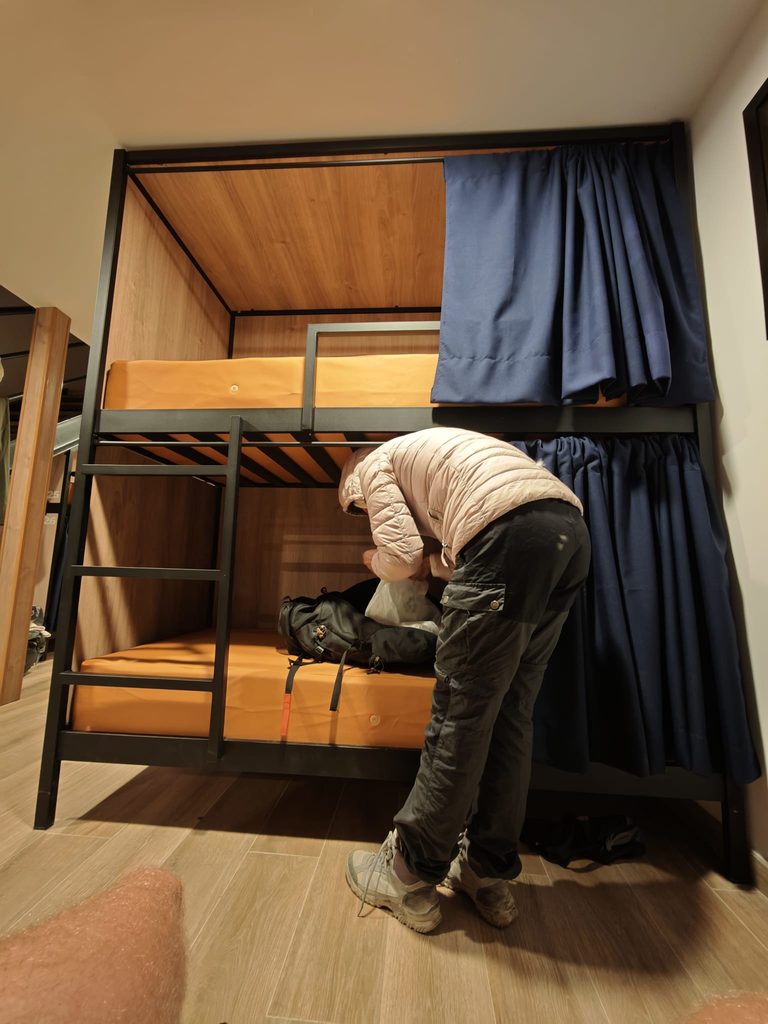
What the refuge has and what it does not
There is a fully equipped kitchen: cutlery, plates, bowls, a fridge, kettles and microwaves. You can heat your own food and eat like a human being.
You can also buy freeze dried meals on site: add boiling water and you are done. Plus snack bars, a drinks machine and souvenirs.
Two things you need to know before you set off:
Sleeping bag. Bring your own. There is no bedding.
Water. There is water in the tap, but a sign says "agua no potable", not for drinking. You carry your water up or buy it from the machine. Count what you need for the evening, the night and the morning climb to the summit.
The summit permit is included in the night
The last stretch, the Telesforo Bravo trail, normally needs a separate permit. They run out weeks ahead, and non residents pay €15 for one. With a refuge booking you do not arrange anything and you do not pay a cent more. There is one condition: you have to be off the summit trail before 9:00.
A night at 3,260 m and altitude sickness
I will be honest here. We did not sleep.
We lay in our beds for 6 hours and sleep never came. That is a classic at this altitude. Your body runs at higher revs and refuses to switch off. A few hours earlier we had been at sea level, after all.
It did not ruin the plan, though. Six hours of lying down without sleep is still rest. Your legs recover, your heart rate drops, your body gets used to the height. In the morning we both felt ready.
Important: sleeplessness and a light headache are normal. A strong headache, nausea or vomiting are not. Then you go down. The mountain will wait.
5:00: leaving for the summit of Teide
We did not need an alarm. At 5:00 we set off with head torches. Dark, cold, stars overhead. Teide has some of the clearest skies in Europe, and at night you can see that with the naked eye.
From the refuge you walk to La Rambleta, and from there the Telesforo Bravo trail takes you to the very top. The last stretch is short but steep. You can smell sulphur, and warm air blows out of the cracks.
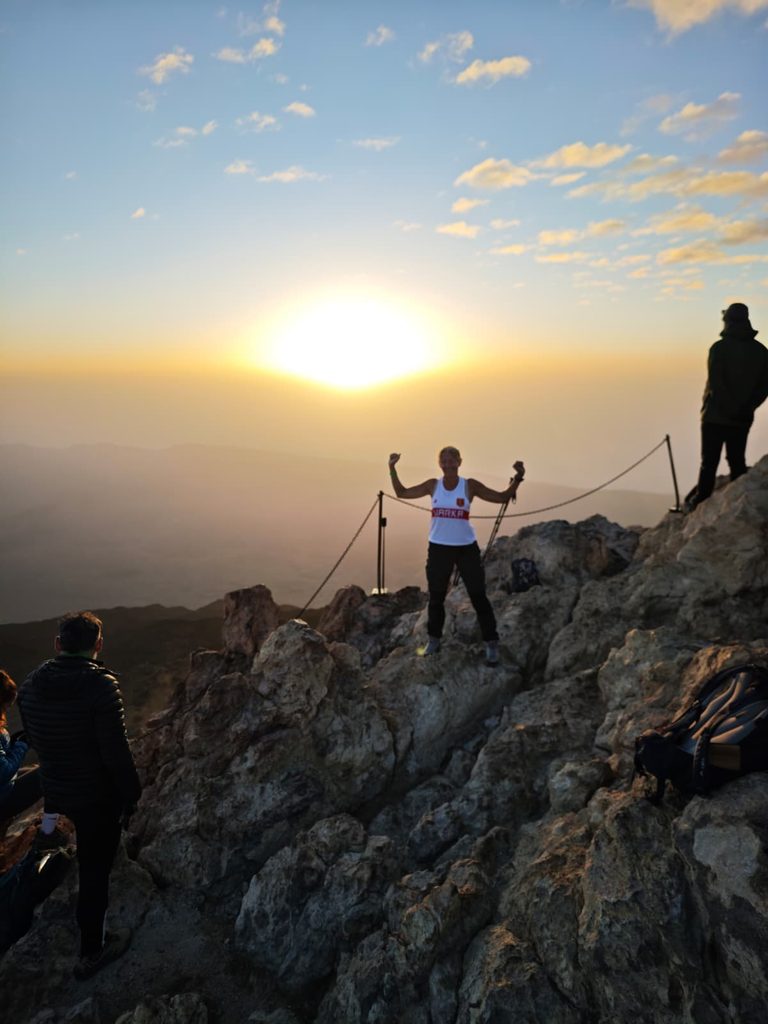
At 7:00 we stood on the summit. 3,715 m, the highest point in Spain. The thermometer showed about 8 degrees. The day before it had been over 30 on the coast. On the summit you stand still and wait for the sun, so the cold bites much harder than when you are moving. A hat, gloves and a down jacket in your pack are not overkill, even in September. In winter there is frost and ice up here.
Then the sunrise. The sky changes colour by the minute, and on the other side the shadow of Teide appears: a perfect triangle that lies across the ocean and reaches beyond La Gomera.
Teresa looked at the crater for a long time. In the end she said she had imagined the volcano at the top completely differently. Many people do. There is no big hole full of lava. There is a small hollow, yellow sulphur crusts and steam seeping from the rocks. The volcano does not put on a show. It just breathes.
Down to the cable car, and plan B
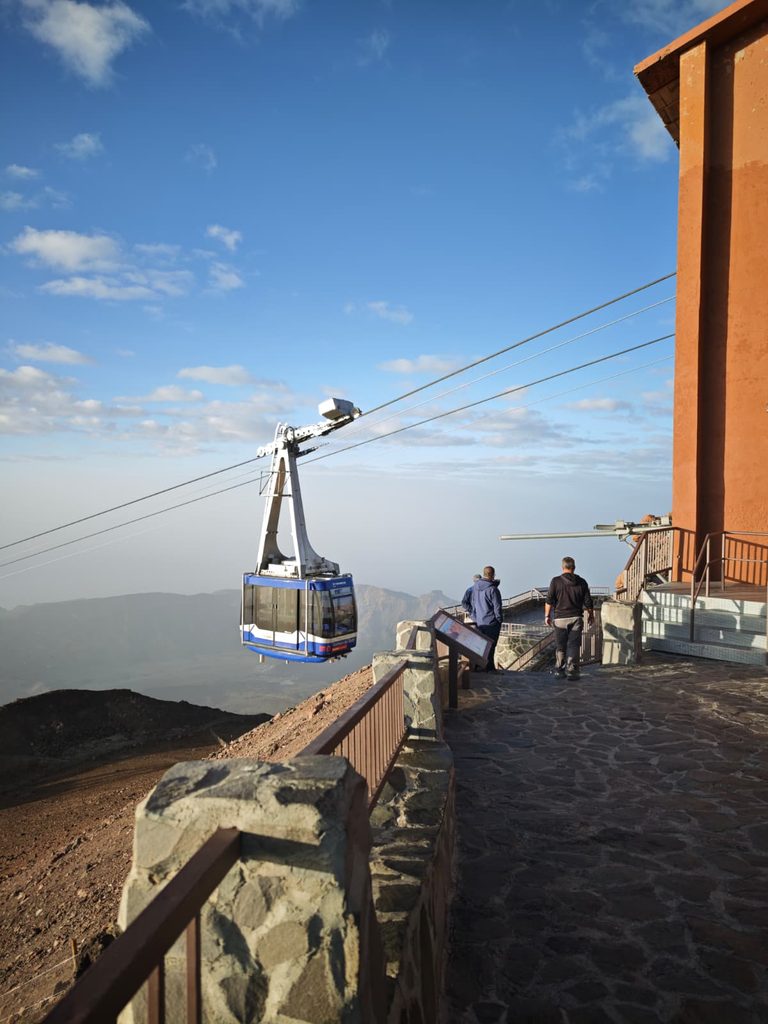
From the summit it takes about 15 minutes to walk down to the upper cable car station. One important thing: the cable car only starts at around 9:00. We were down much earlier and simply waited. Standing still gets cold, so the warm layers come in handy a second time. The ticket down is paid separately.
And a second important thing: the cable car may not run at all. In strong wind it stays closed, and nobody can tell you in the evening what the morning will bring. Then the only way is on foot down to Montaña Blanca, a few hours on loose gravel. Plan the energy, the water and the time for it. If you have a flight in the afternoon, it is not a good day for Teide.
Climbing Teide at a glance
- Start: Montaña Blanca car park, about 2,350 m
- To the Altavista refuge (3,260 m): 2 h for us, usually 3 to 4 h
- From the refuge to the summit (3,715 m): about 2 h
- From the summit to the cable car: about 15 min, cable car from around 9:00
- Night at the refuge: €71 / €56.80 / €29
- Summit permit: included in the night, off the trail before 9:00
- Temperatures in September: about 20°C at the car park at 18:00, about 14°C after sunset, about 8°C on the summit in the morning
- Bring: sleeping bag, water, head torch, warm layers, hat, gloves, food
- Plan B: walk down if the cable car is not running
Can anyone climb Teide on foot?
No. And it is better to know that before you start than halfway up.
Teresa is 60, but she has trained regularly for years. She came here for an active holiday, not for a sunbed. Standing on the roof of Spain at 7:00 after a sleepless night did not come out of nowhere.
The numbers are simple. From the car park to the summit there are almost 1,400 m of ascent. Most of it is above 3,000 m, where every step costs more than it does lower down. Add a night with practically no sleep and a 5:00 start in the dark and the cold. Technically the trail is easy: no climbing and no exposure. Physically it is not easy.
A few honest questions to ask yourself before booking:
- Do you comfortably do full day mountain routes with a lot of ascent?
- Have you been above 3,000 m before, and do you know how your body reacts?
- Do you have the strength to walk down if the cable car does not run?
If it is three times "yes", go. It will be one of the best things you do in Tenerife. If not, start with something shorter and come back for Teide next year.
One more thing. Everything I have described applies to summer conditions. In winter there is snow and ice on Teide. Then it is a completely different mountain: crampons, an ice axe, winter experience, and the trails are sometimes simply closed. A September report is not a manual for January.